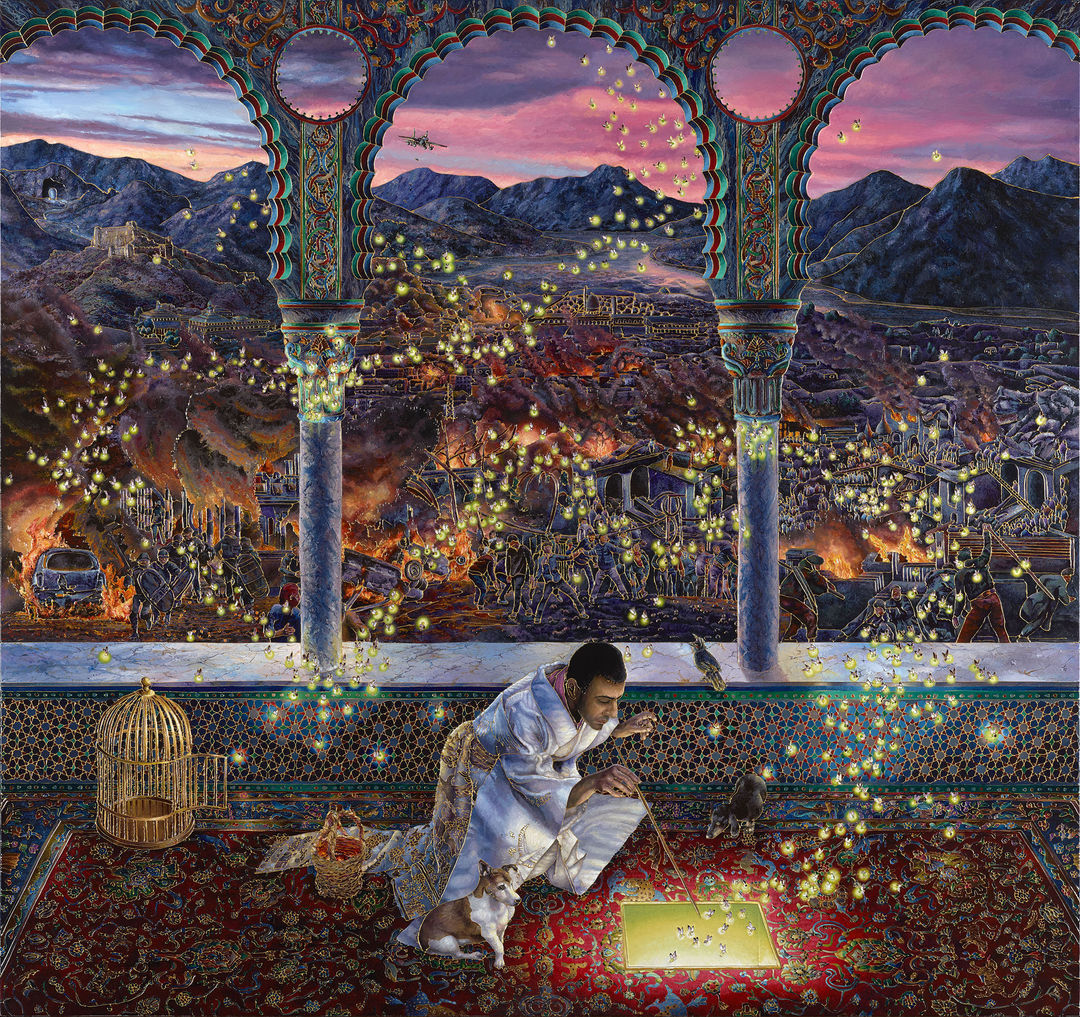
The Museum of Fine Arts, Houston presents ‘Raqib Shaw: Ballads of East and West’. The exhibition weaves narratives that connect Shaw’s childhood memories of growing up in Kashmir with powerful visual reflections on the urgent climate crisis. Some paintings depict paradisiacal scenes, while others offer Boschian landscapes engulfed in flames. In ‘Ballads of East and West’, Shaw envisions a world where these dichotomies are subsumed into a realm of imagination. The exhibition will be on view at the Museum’s Audrey Jones Beck Building.
Raqib Shaw is an internationally renowned painter, whose work echoes across centuries and continents articulating a dialogue between East and West. Based in London, the artist lived most of his childhood in the Indian city of Srinagar, a ‘Heaven on Earth’ encircled by Himalayan mountains, lakes, and magical gardens. The Kashmir he knew as a child no longer exists, marred by political insurgencies. For Shaw, Kashmir represents a trampled Eden—a paradise lost—and references to the beauty and trauma of his childhood abound in his work.
Shaw’s paintings are flamboyant, fantastical, and extremely labor-intensive. They are puzzles that always include certain key ingredients: self-portraiture, landscapes in peril, references to historic painting, or moments from his own life. Shaw frequently depicts himself as satyr, a joker, a saint, a philosopher, or a blue-skinned divinity clad in sumptuous robes. The sensuous, glossy intensity of the jewel-like painting surface is rendered in infinite colors and shades with a painstaking technique—enamel paint, applied with porcupine quills to birch wood panels.
“It’s only in person . . . that you see how simply astonishing Shaw’s technique is.” —Washington Post
He paints with porcupine quills and fine needles to render the precise details of delicate flowers or distant mountains, which are outlined in embossed gold. Jewels, glitter, and semiprecious stones further enhance the opulence of the scenes, beguiling viewers through the iridescent shimmer of the surfaces, even as they sense the sadness that lurks beneath the glamour. Upon closer examination, conflict is present in almost every painting, evoking Kashmir’s turbulent history.
The Houston installation of this nationally touring exhibition also introduces two of the artist’s newest tapestries. Addressing the global threat posed by climate change, Shaw deftly weaves together not only East and West, but also beauty and conflict, hope and longing.